

It’s exciting to see what a new technology can do, and I personally wanted to get to know AI before I dismissed it on artistic and philosophical grounds. The pleasure of novelty is real, and I indulged in it! I loved writing and tweaking prompts, editing a bit in a photo editor, and using the edited image as the base for a new AI work. In this way, I made new covers for some literary classics, such as The Jungle Book:

My attempts highlight an aspect of AI generated images that I wonder if is intrinsic to “AI art,” because it seems to always be there: that it is so sugary! Almost all “AI art” I’ve seen would qualify as what we in Sweden call “hötorgskonst,” that is, overly sentimental paintings of little artistic value, mass produced for the masses (the name means art that was sold on Hötorget, the “hay market,” in central Stockholm). Think the famous motive of The Crying Boy:
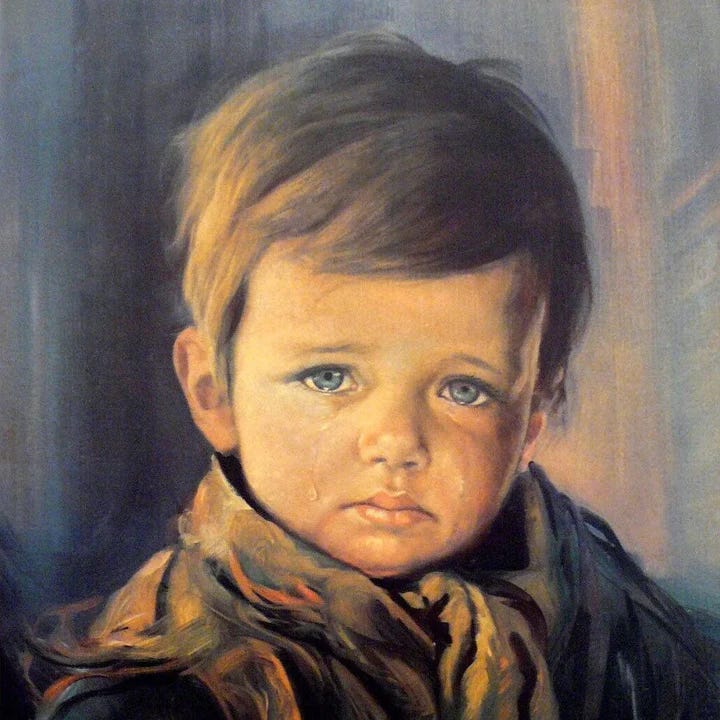
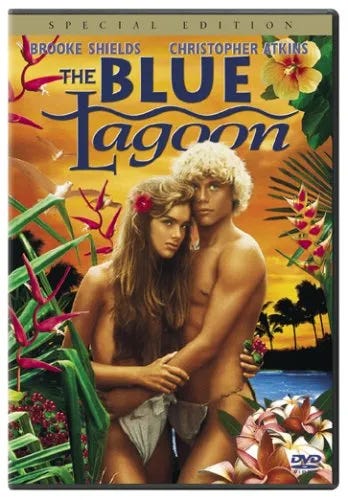
But also think the kind of airbrushed paintings that would end up on posters in boy rooms (I had one with a panther myself) or on car hoods. Think a howling wolf in front of a full moon on a t-shirt. The kind of art that everyone knows is not of high quality, but which somehow manages to appeal directly to our senses – you just can’t look away. It’s like pure dopamine: the cover of a romance novel that will do all it can to awaken your desire. Sometimes it feels like all “AI art” is a variation of the film poster for The Blue Lagoon (1980):
When I showed my experiments with “AI art” to a friend, he had to look away. Being addiction-prone, his first comment was “slot machine.” What he meant was the way slot machines (or whatever they are called nowadays) at bars are designed to keep the user engaged through a whole arsenal of visual and aural stimuli. Japanese pachinko machines well manifest this sensory overload:
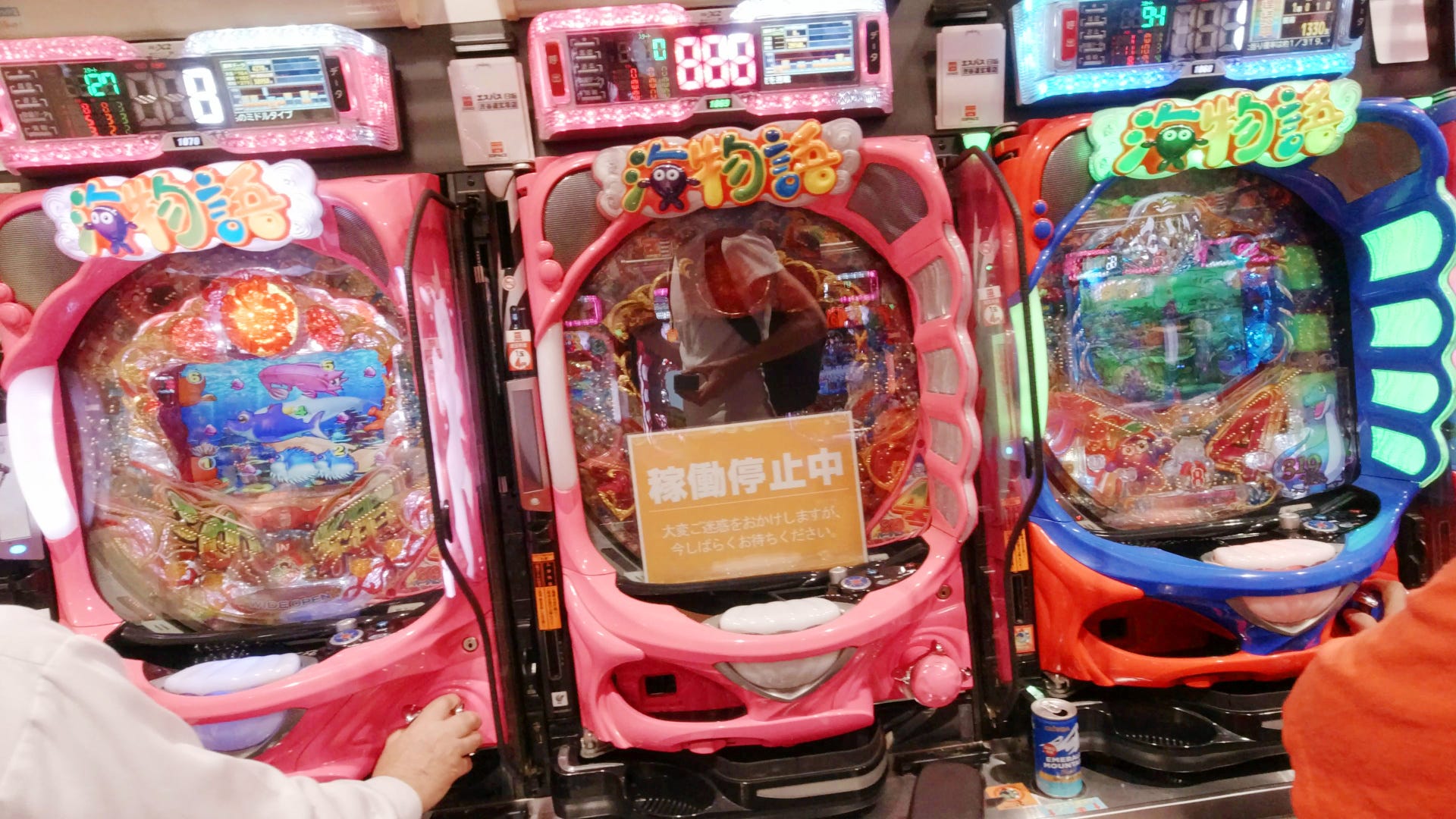
He had spent many a night in front of such dopamine machines, and looking at my images, he got the same feeling. The skin is a bit too shiny, the eyes a bit too big, the muscles a bit too enhanced. In fact, everything that engages us is enhanced – this too is a sensory overload! The result should logically depend on the AI model used, but so far, all “AI art” that I’ve seen seems to work this way. It gives us what we want. And too much of it.
Welcome to the Lagoon!
But I didn’t only make images. I let the AI write a novel for me. And then another one. In the end I had a ten part novel series about the adventures of a distant tribe. All boys, of course! I even published the whole thing on Amazon, Apple Books and Google Play, including AI made audio versions on the latter.
And it was addictive! Me writing a prompt for each chapter, the AI delivering the text in seconds. Was it good? No! The style was as cheesy as the images were sugary, like the text version of airbrushed paintings. The language was full of clichés, for the simple reason that that is what AI is: a concoction of previously published human expressions. A literal cliché.
But the story was mine, and that’s what made it exciting to continue “writing” it. Each book took me about a day to finish, because of course I edited it a bit too, and made a smashing cover. And then the publishing admin. It filled my days – I was completely immersed in this for some time. I even had to make a family tree of the tribe to keep the characters from becoming too incestuous:
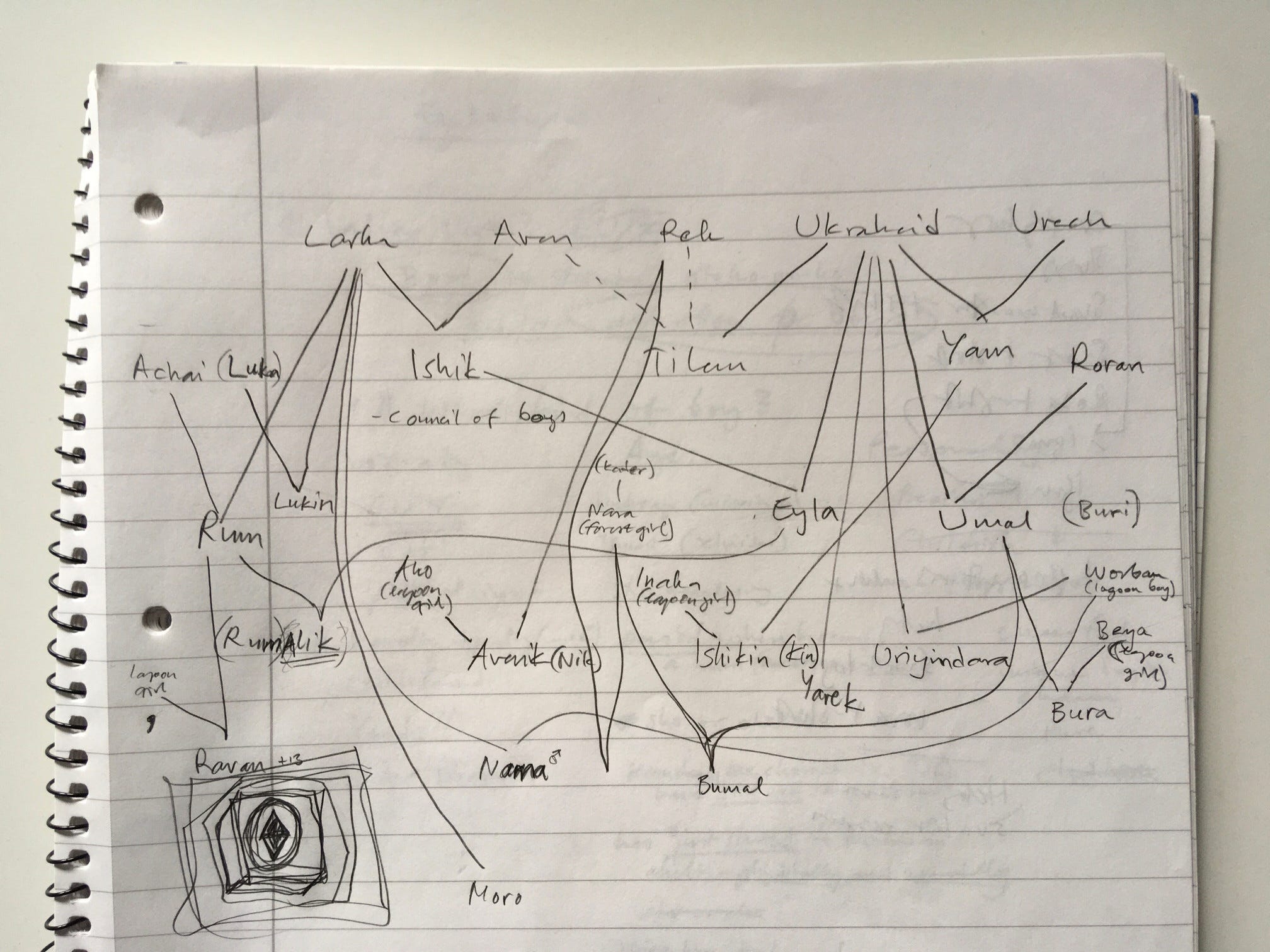
I came up with the names, of course. In fact, as the story progressed, I got irritated with more and more that the AI wrote, and my prompts became longer. They could look like this:
Write chapter 84. As Umal takes off his tunic, the bleeding marks on his body from the bird’s clutches are exposed. Rek carefully tends to Umal’s wounds. But then Umal notices with dismay that Rek is injured too. The thorns of the cacti have ripped the smooth skin of his young body. Rek tells Umal not to worry about him, but Umal worries that the cacti might be poisonous.
Or like this:
Next chapter. Describe Rek’s and Umal’s hardships in the thorny jungle and how they eventually reach a hidden lagoon, lush with flowers and rich with resources. They are taken captive by the inhabitants and put in a small cell made out of clay, but the villagers are kind and give them fresh fruit to eat. However, the prison guard tells them in confidence that no one who gets imprisoned in the lagoon gets out alive. The reason for this is that they want to keep the existence of the lagoon a secret to the outside world, and since Rek and Umal have discovered their secret, they must face the proper punishment. The only one who can pardon them is the lagoon chief. Rek asks to see the lagoon chief, and the guard tells them that he is a powerful man that no one ever objected to. He is also described as a beautiful young man with an unstable temper. After one week of fruit diet in the cell, Rek and Umal are finally able to meet the chief of the lagoon. They are shocked upon realizing that the chief is no other than Aven. They have finally found their lost friend.
Exciting! Note that I couldn’t write that Umal and Rek would be “killed” – it was against the AI’s rules to be that violent. Hence “face the proper punishment” instead.
I’m not linking to these novels because I don’t want you to accidentally buy them. I myself can’t stand that saccharine AI language anymore, although the story I gave the AI is quite exciting, so full of twists and turns and relations and drama that it reminds of Desperate Housewives goes Lord of the Flies, or maybe the opposite way around. It was an experiment, and if anything, it made me want to write fiction myself next, instead of letting an AI pump out all the predictable words and phrases.
But yeah, I can totally get the thrill people get when “creating” something through prompt writing. Again the slot machine metaphor is apt: what keeps us prompting is that we want to see if the next result can be better, if we only change this little thing in the prompt ... just one more ... and one more ... and then the feeling of “I made this” to top it off. A dopamine technology for our dopamine times.
Tomorrow I’ll share a couple of “AI boys” with you who are paid subscribers, along with my analysis of what they say about our collective unconscious. It will be wild!
/Karl